Frequently Asked Questions

Whiskey is a distilled alcoholic beverage made from fermented grain mash and aged in wooden casks. The primary types include:
  • Malt Whiskey: Made primarily from malted barley.
  • Grain Whiskey: Produced from various grains.
  • Single Malt Whiskey: Originates from a single distillery using one type of malted grain.
  • Blended Whiskey: A mix of different whiskeys from various distilleries.
  • Bourbon: An American whiskey with at least 51% corn content.
  • Scotch: Whisky distilled and matured in Scotland.

The basic process involves:
  • Mashing: Grains are ground and mixed with water to create a mash.
  • Fermentation: Yeast is added to ferment the sugars into alcohol.
  • Distillation: The liquid is distilled to separate alcohol from impurities.
  • Aging: The spirit is aged in barrels, often made of oak, to develop flavours.

Fermentation typically takes 48 to 96 hours. Longer fermentation can lead to fruitier and more complex flavours.

Absolutely. Distillers often use specific yeast strains that produce desirable fruity, floral, or spicy flavours.

Common grains in whiskey production include barley, corn, rye, and wheat. The choice of grain influences the whiskey's flavour profile.

Malted barley provides natural enzymes that convert starches into fermentable sugars during mashing, which is essential for fermentation.

Peated malt is barley that has been dried using peat smoke to impart a smoky flavour. The level of peat is measured in PPM (Phenol Parts Per Million).

Water is crucial in whiskey production, used in mashing, fermentation, and dilution before bottling. The mineral content and purity of the water can significantly influence the final flavour of the whiskey.

  • Scotch: Usually distilled twice, but some exceptions exist with triple distilled Scotch.
  • Irish Whiskey: Often distilled three times for a smoother finish, but some Irish whiskey is double distilled.
  • Bourbon and Rye: Typically double distilled.

Casks, typically made from oak, play a vital role in aging whiskey. They impart flavours, colours, and aromas to the spirit. The type of wood, previous contents, and charring level of the cask all contribute to the whiskey's unique characteristics.

Aging whiskey in wooden barrels imparts flavour, colour, and complexity. The interaction between the spirit and the wood adds notes like vanilla, caramel, and spice, while also mellowing harsh flavours. It is estimated that 50-80% of a whiskey's flavour comes from barrel aging.

The angel's share refers to the portion of whiskey that naturally evaporates from the barrel during aging. It is typically around 2-4% per year.

Cask strength whiskey is bottled directly from the barrel without dilution, often with an alcohol content above 55% ABV.

The location of a distillery influences whiskey flavour through factors like climate, humidity, and air quality.

The word "whiskey" originates from the Gaelic term "uisce beatha," meaning "water of life." Over time, it evolved into "usquebaugh" and eventually "whiskey."

A standard 1.5 oz (45 ml) serving of whiskey contains about 97 calories, with no carbohydrates, fats, or sugars.

A master blender is an expert responsible for selecting and combining different casks of whiskey to achieve a consistent and desirable flavour profile.

Indian Whisky

Indian whisky is a distilled alcoholic beverage generally made from a mix of molasses-based spirit and grain-based spirit. Unlike Scotch (100% malted barley) or American whiskey (corn-heavy bourbon, rye whiskey, etc.), many Indian whiskies historically used molasses as a base. Today, premium and single malt Indian whiskies are made entirely from grains (usually barley, sometimes other cereals).

Ingredients vary by brand and type:
  • Mass-market brands: Often use neutral spirits from molasses, blended with a small portion of grain/malt whisky and flavouring.
  • Premium and single malt whiskies: Made using barley or other grains, mashed, fermented, distilled, aged in oak barrels.

The production process typically includes:
  • Fermentation: Grains or molasses are fermented with yeast to produce alcohol.
  • Distillation: The alcohol is purified using pot stills (for flavour) or column stills (for volume).
  • Blending: Many Indian whiskies are blends of neutral spirit and malt whisky.
  • Maturation (optional): Premium Indian whiskies are aged in oak barrels, which gives them colour, smoothness, and complexity.
  • Bottling: Once blended and diluted to about 42.8% ABV (Indian standard), the whisky is bottled.

Molasses is a by-product of India's massive sugar industry, making it cheap and widely available. It's fermented and distilled to produce ENA (Extra Neutral Alcohol), then blended and sold as "whiskey" under Indian regulations.

Due to India's hot climate:
  • Angel's Share (evaporation loss): Can reach 8–12% per year
  • The high temperatures accelerate the maturation process—roughly, 4–6 years of aging in India can deliver maturity comparable to much older Scotch (often quoted as ~3× in Scotland), though the flavour profile is not identical.

Indian producers use:
  • Ex-bourbon barrels (most common)
  • Sherry casks
  • Wine/rum barrels for finishing (in premium variants)

  • Chill-filtration is often used to remove cloudiness
  • Caramel colouring (E150A) is legal and commonly used to maintain colour consistency, especially in blends

Flavour varies by category:
  • Molasses-based blends: Smooth, lightly sweet, and easy to drink, but lack complexity
  • Grain-based blends: Offer richer notes of spice, oak, and vanilla
  • Single malts from India: Internationally acclaimed for their bold flavours, tropical fruit notes, and smoky or peaty character — comparable to high-end Scotch whiskies

Key categories include:
  • Mass-market Blended Whisky: Inexpensive, often molasses-heavy
  • Grain Whisky / Premium Blends: Higher-quality blends with grain spirit and malt
  • Single Malt Whisky: 100% malted barley, pot-distilled, aged
  • Craft / Boutique Whiskies: Small-batch, often aged longer and using specialized barrels

Single Malt Watch Video

Single malt whiskey is a distilled spirit produced from 100% malted barley at a single distillery. The term "single" refers to one distillery, and "malt" indicates that the whiskey is made exclusively from malted barley. This production method often results in a rich and complex flavour profile.

Single malt whiskey is made exclusively from malted barley. No other grains are used, distinguishing it from other whiskey types.

  • The barley is soaked in water, allowing it to germinate.
  • After germination, the barley is dried using hot air or peat smoke in a kiln.
  • Peated barley imparts a smoky flavour, often found in Islay single malts.

Pot stills are used to produce single malt, which are traditional copper stills that produce a richer and more characterful spirit. The shape and size of the still influence the flavour by controlling how much copper interacts with the spirit.

Single malts are commonly aged in:
  • Ex-Bourbon Barrels: Provide vanilla, caramel, and oak flavours.
  • Sherry Casks: Impart fruity, nutty, and spicy notes.
  • Wine or Port Casks: Add rich, complex fruit flavours.

Single malt whiskeys offer a diverse range of flavours influenced by factors such as the distillery's location, production methods, and aging conditions. Common flavour notes include:
  • Fruity: Apples, pears, or citrus.
  • Malty: Biscuits or cereal.
  • Sweet: Honey, caramel, or toffee.
  • Spicy: Cinnamon or nutmeg.
  • Smoky: Peat or wood smoke

Single malt whiskeys are often priced higher due to factors such as traditional production methods, longer aging processes, and the use of high-quality ingredients. Additionally, limited production volumes and the time-intensive nature of crafting single malts contribute to their higher cost.

No. While Scotch Single Malt is the most well-known, single malt whiskey is also produced in countries like India, Ireland, Japan, and the U.S.

Factors that influence flavour include:
  • Fermentation time.
  • Still shape and size.
  • Cask type and aging period.
  • Storage environment (temperature and humidity)

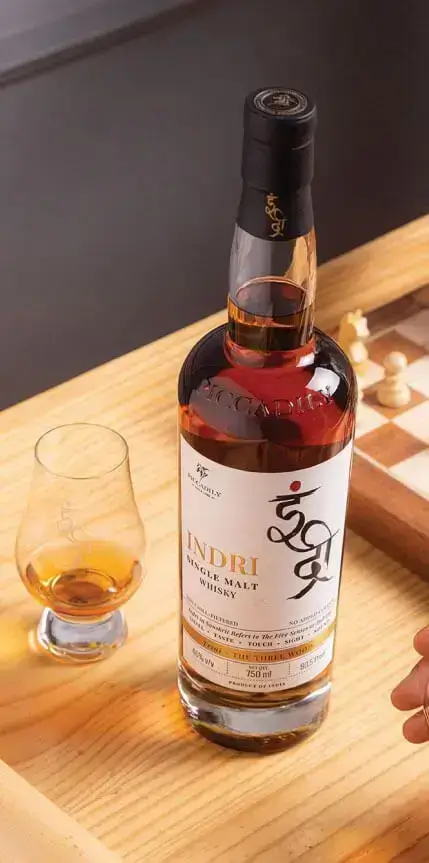
Indri is crafted from six-row Indian barley and matured in a combination of ex-bourbon, French wine, and PX sherry casks. This triple cask maturation imparts a complex flavour profile with notes of dried fruits, spices, and vanilla. The whisky is distilled in traditional Scottish-style copper pot stills, emphasizing artisanal production methods.

Indri offers several expressions:
  • Indri-Trini: The flagship triple cask expression.
  • Indri-Dru: A cask strength variant matured in ex-bourbon casks.
  • Indri Agneya: Lightly peated, matured in sherry and bourbon casks.
  • Travel Retail Exclusive: A triple cask edition available at duty-free outlets.
  • Diwali Collector's Edition 2023: A PX-sherry peated special release.
  • House of The Dragon Exclusive Edition: A limited edition inspired by the popular series.
  • The City Series – Bengaluru Duty Free Edition: A city-themed special edition.
  • Indri Founder's Reserve 11-Year-Old: Matured in ex-Bordeaux red wine casks for 11 years; dedicated to founder Pt. Kidar Nath Sharma.

Indri has achieved significant international acclaim:
  • Whiskies of the World Awards 2023: Best in Show, Double Gold for the Diwali Collector's Edition 2023
  • World Whiskies Awards 2024: Best Indian Single Malt for Indri Dru, the cask strength expression
  • VinePair Awards 2024: Named Best New World Whiskey for Indri-Trini, India's first triple cask single malt
  • Miami Global Spirit Awards 2025: Named Best New World Whiskey
  • Las Vegas Global Spirits Awards 2025: Named Best New World Whiskey for the Diwali Collector's Edition 2025 Marsala Cask Finish
  • Scoring: 99.1 points out of 100